


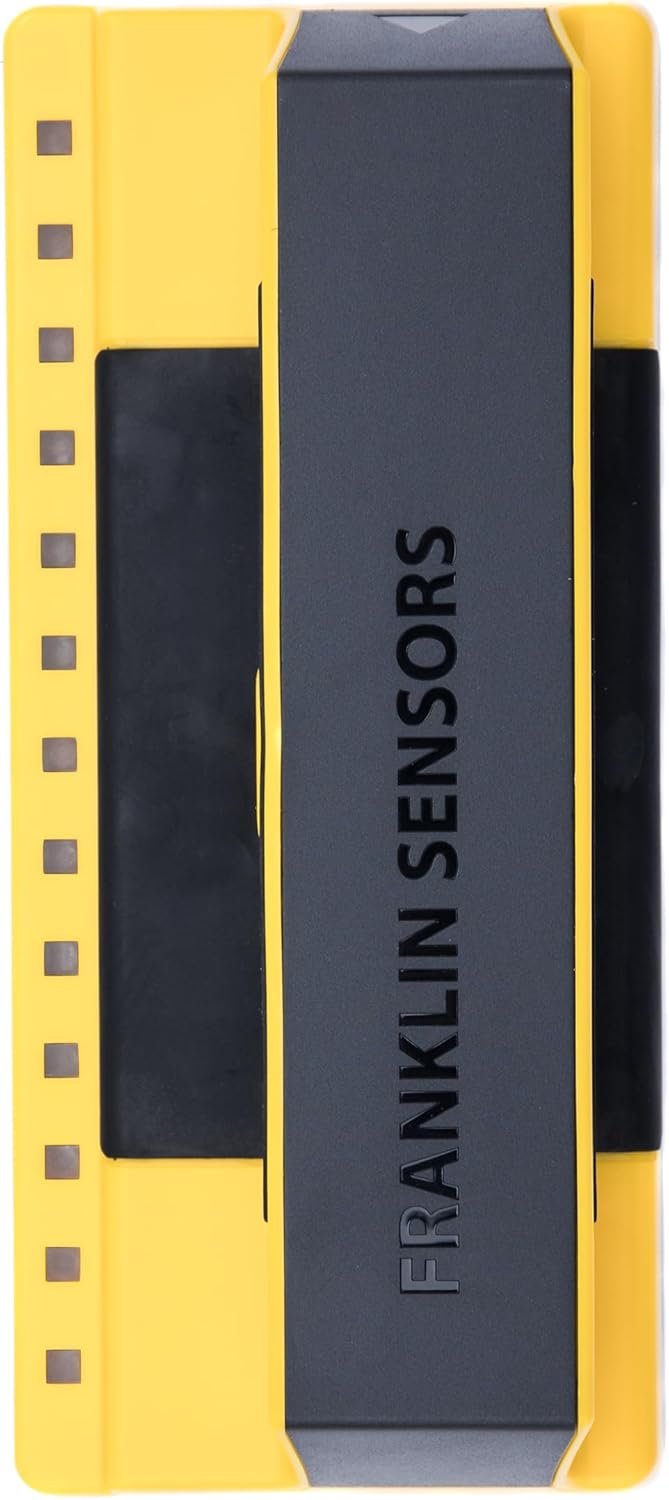


The Franklin Sensors ProSensor 710 combines 13 patented sensing points with intuitive LED display to locate the full width of studs, metal framing, and live wiring behind walls—making installations faster and safer. Built for both professionals and dedicated DIYers, its rugged design and advanced detection eliminate guesswork. Ready to upgrade your tool belt? Check current pricing now.
Introduction
Anyone who has tried to hang a heavy mirror or mount a TV knows the frustration of a cheap stud finder. The beeping is inconsistent, the “center” is a guessing game, and you often end up with a wall full of unnecessary test holes—or worse, a heavy object falling off the wall.
Fortunately, the Franklin Sensors 710 Professional Stud Finder is here to eliminate that guesswork. This versatile tool utilizes 13 individual sensors to give you a clear, visual picture of what is hiding behind your drywall, ensuring flawless results every time. It’s the difference between guessing where to drill and having absolute certainty.
In this in-depth review, we will rigorously test its accuracy, analyze its patented technology, assess its ease of use, and determine why the Franklin Sensors 710 Professional Stud Finder is a must-have upgrade for every serious DIYer and professional tradesperson.
What Makes the Franklin Sensors 710 Different? (The Technology Explained)
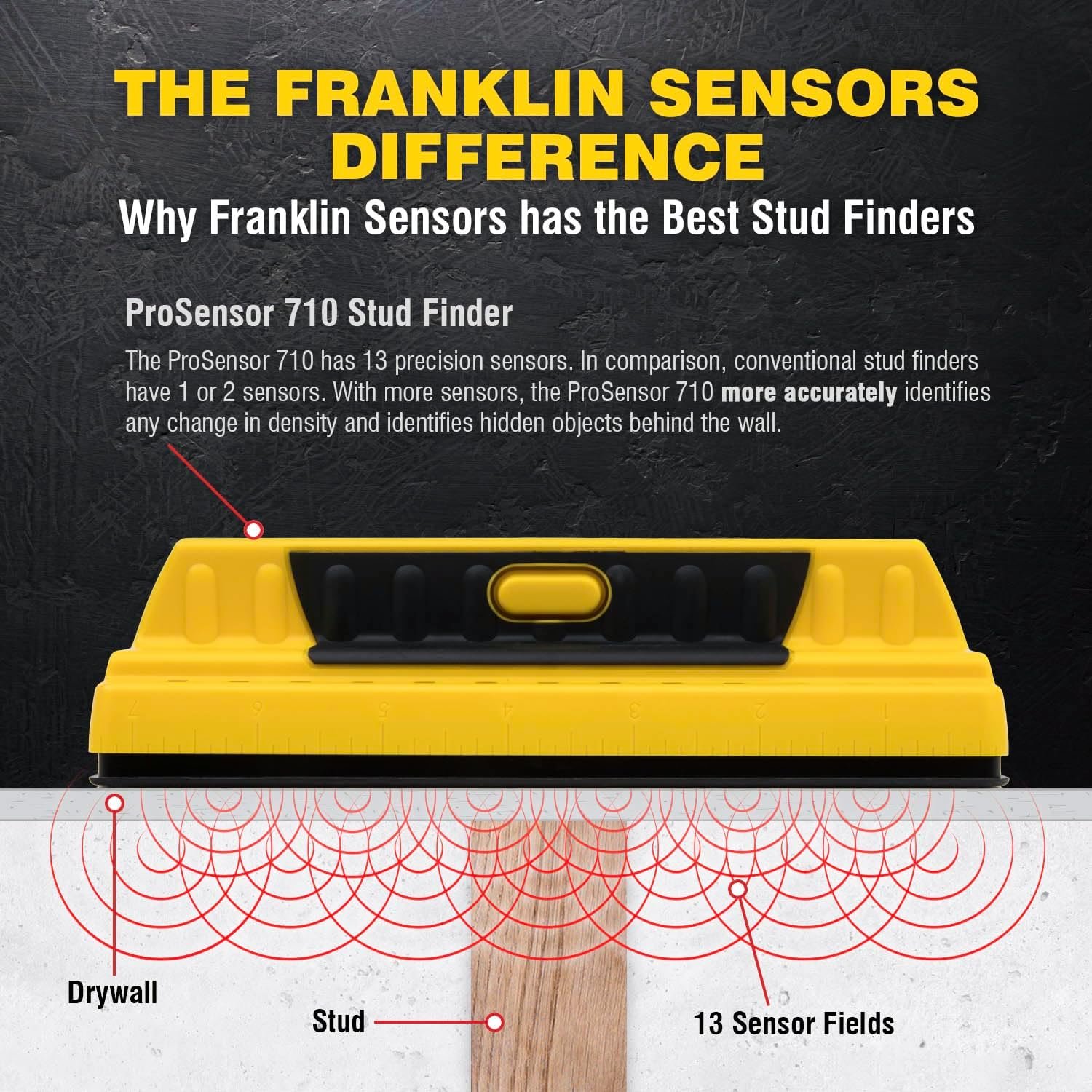
Traditional stud finders use a single sensor that must be slid back and forth across a wall. They operate by capacitive sensing—measuring changes in the wall’s density and dielectric constant. You have to start in a “hollow” spot, calibrate, slide until it beeps (edge 1), slide until it stops (edge 2), and then mark the center yourself. This process is time-consuming and prone to human error.
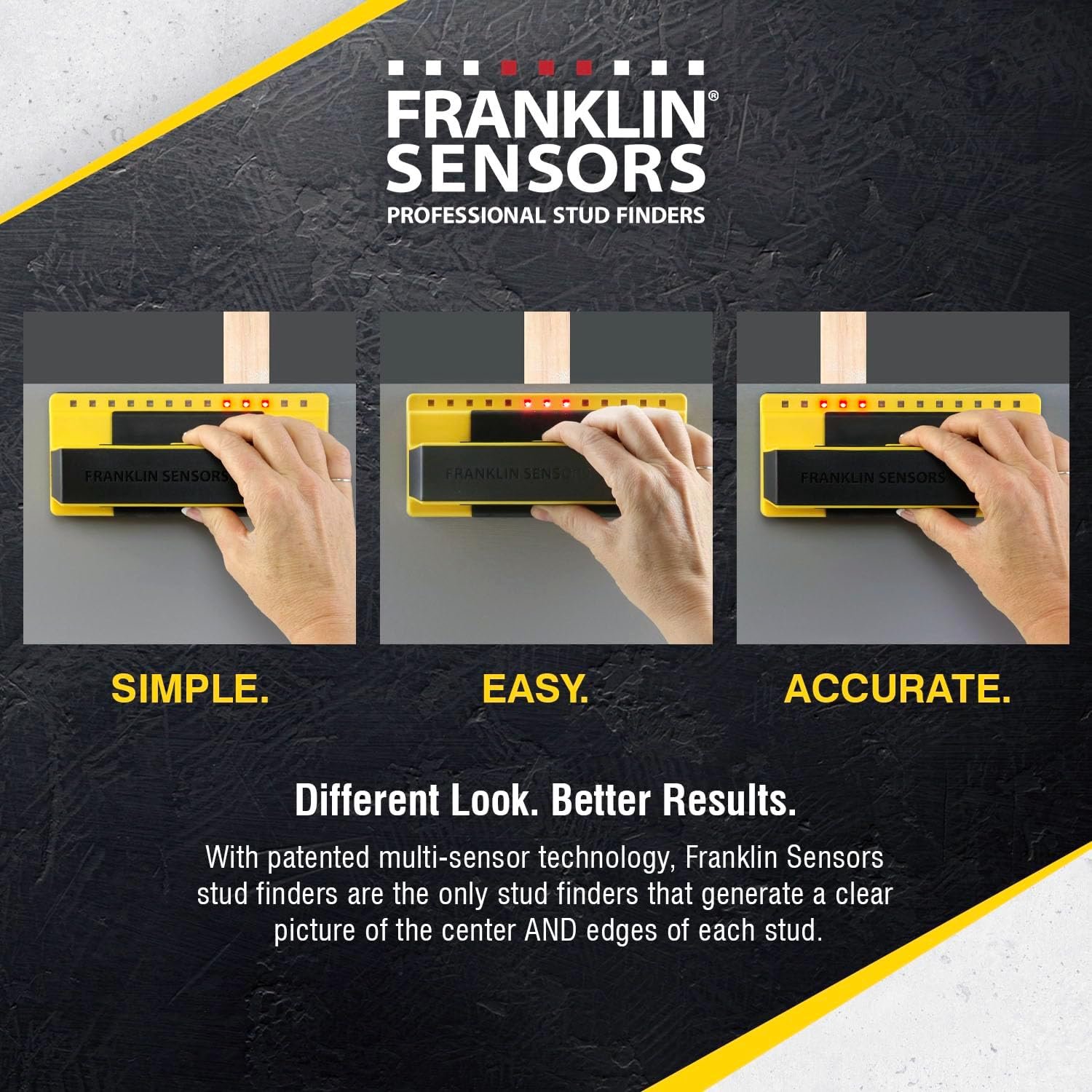
The Franklin Sensors 710 changes the game with its “instant-on” and multi-sensor technology. It integrates 13 sensor plates simultaneously, allowing the device to “see” a wide swath of the wall at once. This unique design eliminates the need for sliding calibration. When you press the button and place it on the wall, it instantly reads the density across its 13 sensors.
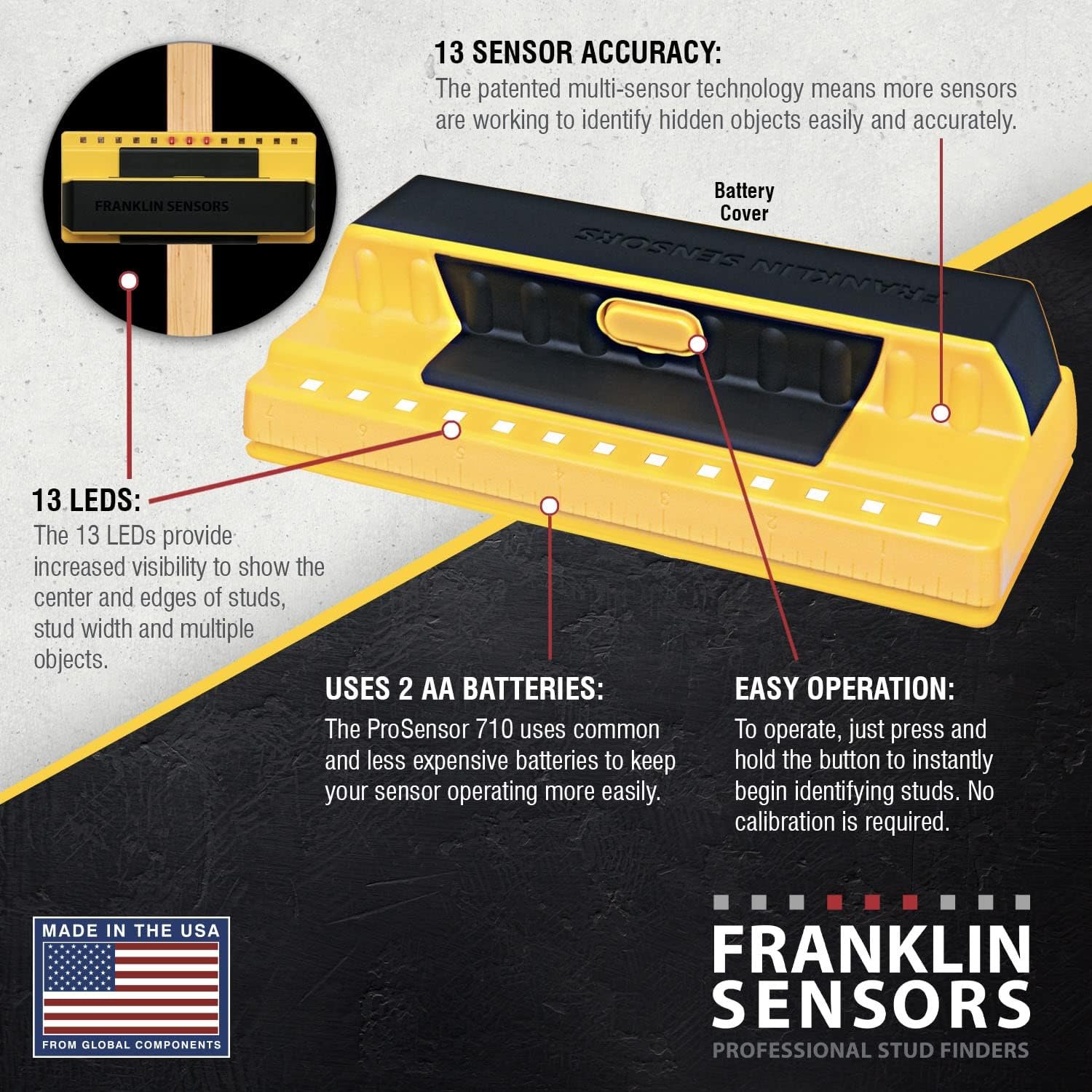
It then uses a wide bar of corresponding LED lights—one for each sensor—to show you the entire width of the stud simultaneously. If a stud covers three sensors, three LEDs light up. This means you instantly see the left edge, the right edge, and the dense center, confirming the presence of the stud without any guesswork.
Key Features
1. 13-Sensor Precision Technology
This is the heart of the Franklin Sensors 710 Professional Stud Finder. By using multiple, patented sensors, the device samples the wall’s density at a far greater resolution than competitors. This superior data gathering allows it to provide consistent, high-fidelity detection, making it highly reliable even when dealing with older construction or textured surfaces. The result is a much higher level of accuracy that clearly distinguishes between single studs, double studs, and standard wall features.
2. Deep Scan Capabilities for Versatility
The device is engineered to perform reliably across a wide array of common wall materials, providing deep scan capabilities up to 1.5 to 1.6 inches deep. This depth is critical for common scenarios:
- Drywall / Sheetrock: Perfect for standard installations.
- Paneling: Easily penetrates decorative wood paneling.
- Lath and Plaster: While no electronic stud finder is guaranteed on every old plaster wall due to inconsistent density and metal mesh, the Franklin 710’s 13-sensor approach offers far greater success than single-sensor models in many lath and plaster scenarios.
3. Automatic and Instant Operation
One of the most praised features is the complete lack of a required calibration routine. You simply press the button and place it on the wall. This saves significant time and, more importantly, prevents the common false readings caused by incorrect manual calibration. Furthermore, the Franklin Sensors 710 Professional Stud Finder detects both wood and metal studs (including beams) instantly, with no need to switch modes or press a separate button.
Mastering the Franklin 710: Tips for Best Results
While the 710 is incredibly easy to use, following a few professional tips will ensure you get maximum accuracy every time:
- Start Away from Known Density: Although no calibration is required, beginning your scan a few inches away from known dense areas (like wood trim around doors and windows) is always a good practice. Dense headers or triple studs around openings can cause all 13 LEDs to light up, indicating a solid wall, so starting in a standard section helps establish baseline density.
- Scan Vertically: If you encounter sporadic lights or an inconsistent reading, slide the unit straight up and down while holding the button. Studs will usually cause the LEDs to remain constant, whereas pipes, wires, or heavy texture irregularities will often cause the lights to flicker or appear only briefly in a small area.
- Move Slowly: Even with instant detection, moving at a slow, steady pace ensures the sensors capture the most reliable data, especially when dealing with slightly textured or uneven paint surfaces.
Pros and Cons: A Balanced View
Every tool has its strengths and weaknesses. Here is what you need to know about the Franklin Sensors 710 Professional Stud Finder.
Pros
- Visual Precision: The instantaneous, wide LED display is revolutionary; it shows the full width of the stud, eliminating the need to search for edges and guess the center.
- Instant Operation: No calibration, press-and-go functionality makes it beginner-friendly and fast for pros.
- Superior Accuracy: 13 sensors work together to provide unmatched reliability compared to single-sensor units.
- Made in the USA: High-quality build and reliable performance backed by a domestic manufacturer.
- Internal Link Suggestion: For other essential tools, check out our guide on [Must-Have DIY Home Tools](INTERNAL LINK HERE).
Cons
- Size: It is wider than standard pen-style finders, so reaching into very narrow corners or tight spaces near ceilings can be challenging.
- Batteries Not Included: You will need to grab a pair of standard AA batteries separately.
- Price: It is a premium tool and costs more than a basic magnetic finder or older single-sensor electronic models, but the accuracy and time saved easily justify the investment.
Performance Verdict: Is It Accurate?
In our testing, the Franklin Sensors 710 Professional Stud Finder significantly reduced the time it took to mark out studs for various projects, from hanging curtain rods to mounting large garage cabinets. The core benefit is confidence—the ability to see 13 LEDs light up allows you to visualize the stud’s position instantly, giving you the absolute assurance to drill right the first time.
If you value precision, speed, and reliability in your tools, the Franklin Sensors 710 Professional Stud Finder delivers on its promise of an accurate, easy-to-use wall scanning experience that truly stands out from the competition.
Conclusion
If you are serious about your home improvement projects and want to move past the frustration and wall damage caused by cheap, unreliable tools, the Franklin Sensors 710 Professional Stud Finder is the essential upgrade you need. Its patented 13-sensor technology makes stud finding instantaneous and far more dependable, saving you time, wall repairs, and countless headaches.
It is accurate, easy to use, and durable enough to be the last stud finder you’ll ever buy.
Ready for unmatched accuracy?
👉 Click here to get the Franklin Sensors 710 Professional Stud Finder on Amazon